
Your first week with AI
Listen instead (audio briefing)
A simple five-day plan to build the habit, with one useful result each day.
Why a week, and why small
Habits beat big plans. Fifteen to twenty minutes a day for five days gives you one useful result each day and a feel for where AI helps you most. The plan below works for almost any job.
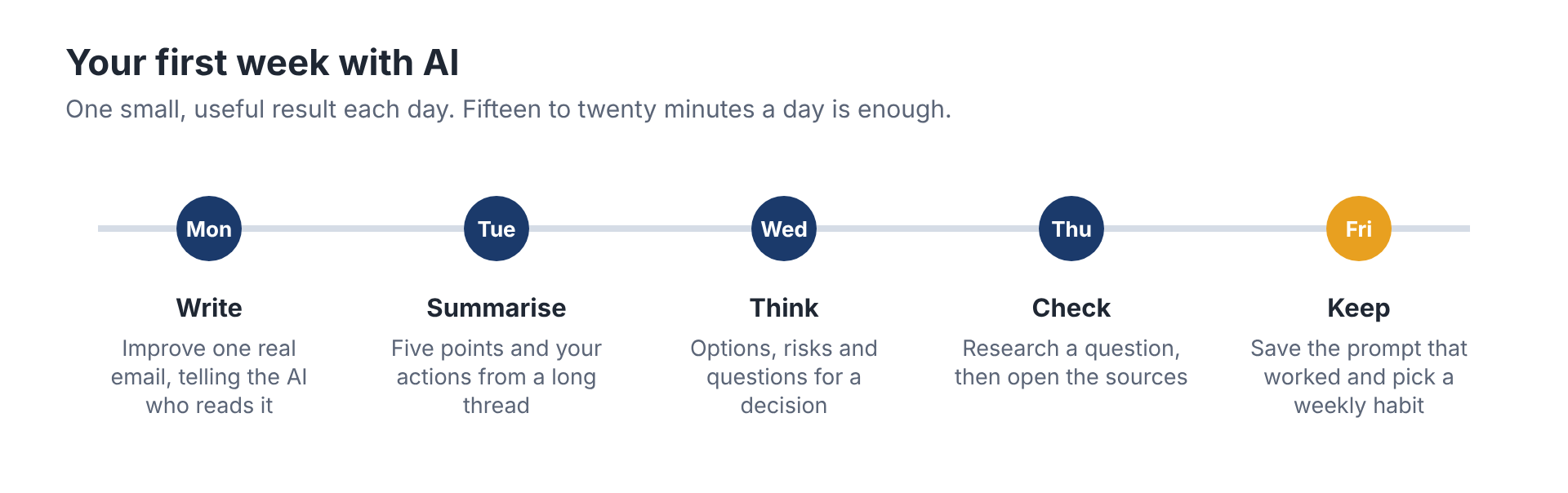
One small, useful result each day.
Monday and Tuesday: write and summarise
Monday: ask an approved assistant to improve one email you need to send, telling it who the reader is and what you need from them. Tuesday: give it a long document or email thread and ask for the five points that matter and any actions for you.
Notice how much better the answer gets when you add context: who, why and what good looks like.
Worked example: Monday’s email
Before: Prompt
Improve this email: [draft asking the warehouse team for stock figures]
What came back
A longer, more formal version of the same email.
Polished, but not more useful.
After: Prompt
Improve this email to our warehouse supervisor, who’s busy and reads on her phone. I need Friday’s stock count for 12 product lines by Thursday 3pm for the monthly report. Make it short, friendly and put the deadline in the first line. [draft]
What came back
Hi Nomvula, could you send Friday’s stock count for the 12 lines below by Thursday 3pm? It’s for the monthly report. Thanks so much, I know it’s a busy week. [list]
Short, clear deadline, easy to act on.
Wednesday and Thursday: think and check
Wednesday: ask it to help you think. Describe a decision or problem and ask for options, risks and questions you haven’t considered. Thursday: ask a factual question in research or web mode, then open the sources and check them.
You’ll see where AI is strong (structure, wording, options) and where you must check (facts, figures, names).
Friday: make it a habit
Look back at the week. Which task saved the most time? Save that prompt somewhere you’ll find it. Pick one task to do with AI every week from now on, and tell a colleague what worked.
Next steps: AI Fundamentals module 1 on prompting with RCICF, and module 6 on using AI safely.
Key points
- Day 1–2: write and summarise.
- Day 3–4: think, then check sources.
- Day 5: save the prompt that worked best.
- One AI task every week from now on.
Common questions
How long should this take each day?
Fifteen minutes is enough.
Which AI tool should I use?
The one your company has approved. If you’re on your own, a well-known assistant on a plan whose privacy settings you’ve checked.
Exercise: Run your first week
Your version: pick the line for your area of work
- Operations: reducing late deliveries on one route
- Finance: cutting the time month-end takes
- Sales and marketing: getting more enquiries from your website
- HR and people: improving how new staff are welcomed
- Customer service: reducing repeat customer calls
- Admin and coordination: cutting time spent scheduling meetings
- Training, L&D or skills development: getting more people to finish a training programme
- Business owner or founder: finding more customers this quarter
- Project or programme management: getting a late project back on track
- Executive team: getting your team to use AI safely
- Other (any role): a problem you’re working on this month
Five days, fifteen to twenty minutes each, on real work. Use an approved AI tool.
Step 1: Monday: improve one email
Pick an email you need to send. Tell the AI who reads it and what you need from them.
Prompt to copy:
Improve this email to [reader], who [what matters about them]. I need [what you need] by [when]. Keep it short and put the request first.

[your draft]
Step 2: Tuesday: summarise a long thread
Paste a long email thread or document, with personal details removed.
Prompt to copy:
Summarise this for me in five bullets: what's been decided, what's still open, and what I need to do, with dates.

[paste]
Step 3: Wednesday: think through a decision
Use it on your task (see “Your version” above).
Prompt to copy:
I need to decide [decision]. Give me three options, the main risk of each, and three questions I should answer before choosing. Ask me questions if you need more context.
Step 4: Thursday: research and check
Ask a factual question in research or web mode. Open at least two of the sources and check they say what the AI claims.
- ☐ You opened the sources
- ☐ You noted anything it got wrong
Step 5: Friday: keep what worked
Save your best prompt with a name. Choose one task you’ll do with AI every week, and tell a colleague.
Hand in: Note your best prompt and your weekly AI task.
Examples by industry: show the learner the line for their sector, or list them all
- Finance & Banking: a reply to an SME client whose overdraft review has been delayed for a second week.
- Retail: a reply to a customer whose couch arrived damaged and two weeks late.
- Insurance: a reply to a policyholder whose storm claim has been waiting for an assessor for ten days.
- Medical & Healthcare: a reply to a patient whose medical aid has rejected a claim for their consultation.
- Sports: a reply to a parent unhappy that their child wasn’t selected for the first team.
- Travel & Tourism: a reply to a corporate traveller whose flight was cancelled the night before a client meeting.
- Legal: a reply to a client asking why their matter has taken three months longer than quoted.
- IT & Technology: a reply to a manager whose team has been without email for half a day.
- Human Resources: a reply to an employee whose leave application was declined during a busy period.
- Logistics: a reply to a client whose urgent load is stuck at the border.
- Manufacturing: a reply to a customer whose order will ship a week late because of a material shortage.
- Public sector and education: a reply to a resident whose complaint about a burst pipe has had no response.
- Agriculture: a reply to an exporter whose container of citrus was rejected at the port.
- Mining: a reply to a community leader complaining about dust and blasting times.
- Energy & Utilities: a reply to a business customer asking why their solar installation is late.
- Property & Construction: a reply to a client unhappy about a delay in the handover of their unit.
- Media & Publishing: a reply to a reader complaining that an article misquoted them.
- Telecommunications: a reply to a business customer whose fibre has been down for two days.
You’re done when: You’ve completed five days, saved a prompt and chosen a weekly habit.