
Spotting fakes and misinformation
Listen instead (audio briefing)
Recognise AI-made fakes, check what you see and share responsibly.
Fakes are easy now
AI can create realistic photos, videos, voices and news-style articles in minutes. Some are jokes; some are scams or propaganda. Seeing is no longer believing.
Three kinds turn up most in South Africa: fake voice notes asking family for urgent money, doctored screenshots of news or bank messages, and investment adverts using a famous person’s face and voice. They work because they look and sound real, and because they push you to act fast.
Check before you believe or share
Ask: who posted it, and are they credible? Is it reported by reliable news sources? Does a reverse image search find the original? Does it play on strong emotions, such as anger or fear? Strong emotion is a warning sign.
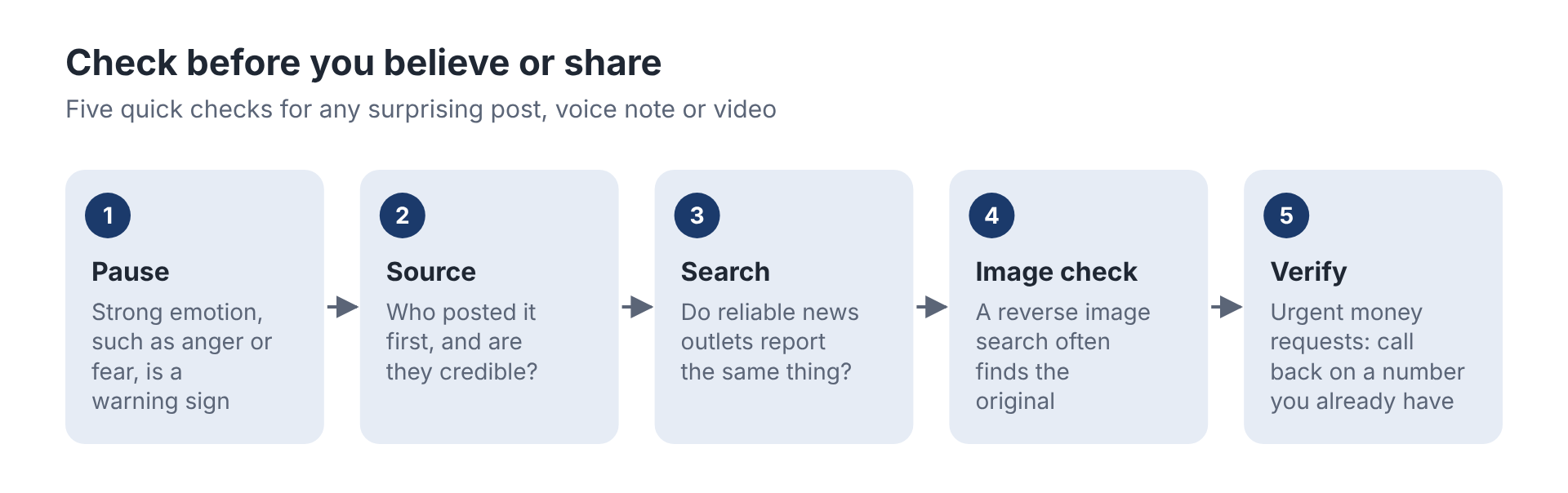
Five checks, in this order. Most fakes fail at the first or second.
Worked example: the voice note from “Mom”
Thabo’s sister got a WhatsApp voice note from an unknown number that sounded exactly like their mother.
Worked example: An urgent voice note asking for money
Before: The message
“It’s Mom. I lost my phone and I’m stuck at the garage, the card isn’t working. Please send R2,500 to this account, I’ll explain later. Don’t call, this phone’s battery is dying.”
Urgency, a new number, a reason not to call and a request for money: four warning signs in one message.
After: What she did
She paused, didn’t reply to the number, and called her mother on the number she already had. Her mother was at home. She asked the family to agree a code word for real emergencies.
Thirty seconds of checking saved R2,500.
Voice cloning needs only a short clip, often taken from social media. A family code word is the simplest defence.
Protect yourself and others
Agree a code word with family for emergency calls. Verify urgent requests for money through another channel. Don’t share what you can’t verify.
If you’ve already shared something false, delete it and tell the group. It feels awkward, but it stops the spread and people trust you more for it.
Key points
- Realistic fakes take minutes to make.
- Check source, coverage and the original.
- Strong emotion is a warning sign.
- Verify urgent requests; share responsibly.
Common questions
Can I spot fakes by looking closely?
Sometimes, but fakes keep improving. Checking the source is more reliable.
What if I shared something false?
Delete it and tell people it was false.
Exercise: Check three things you saw this week
Twenty minutes with posts, videos or messages you actually received. You’ll practise the five checks and set up one protection for your family.
Step 1: Pick three surprising items
Choose three posts, forwards or videos from the past week that surprised you, made you angry or asked you to act.
Step 2: Run the five checks on each
For each, note who posted it first, whether reliable outlets report it, and how strong the emotion is.
- ☐ You found the original source, or couldn’t
- ☐ You searched for it in at least one reliable news outlet
Step 3: Try a reverse image search
Take one image and search for it with Google Lens or a reverse image search. Note where else it appears and when it first appeared.
Step 4: Ask AI to explain the warning signs
Paste the text of one item (no personal details) into an approved AI tool.
Prompt to copy:
Here is a message I received: [paste]. What are the warning signs that it might be false or a scam? What should I check before believing or sharing it? Don't tell me whether it's true; tell me how to check.
Step 5: Agree a family code word
Choose a word or question only your family knows, for any urgent request for money or help. Share it in person, not in the family group.
Hand in: Note what you found for each item, and confirm your family has a code word (not the word itself).
You’re done when: You’ve checked three real items and your family has a code word for emergencies.