
How machines learn, without the maths
Listen instead (audio briefing)
A non-technical look at how AI is trained, why it makes mistakes, and what that means for trusting it.
Learning from examples
Traditional software follows rules a programmer wrote. Machine learning works the other way round: you show the system thousands or millions of examples, and it finds the patterns itself. Show it enough emails marked “spam” and “not spam”, and it learns to sort new ones.
Deep learning uses many layers of patterns, which is why it handles messy things like speech, photos and language so well.
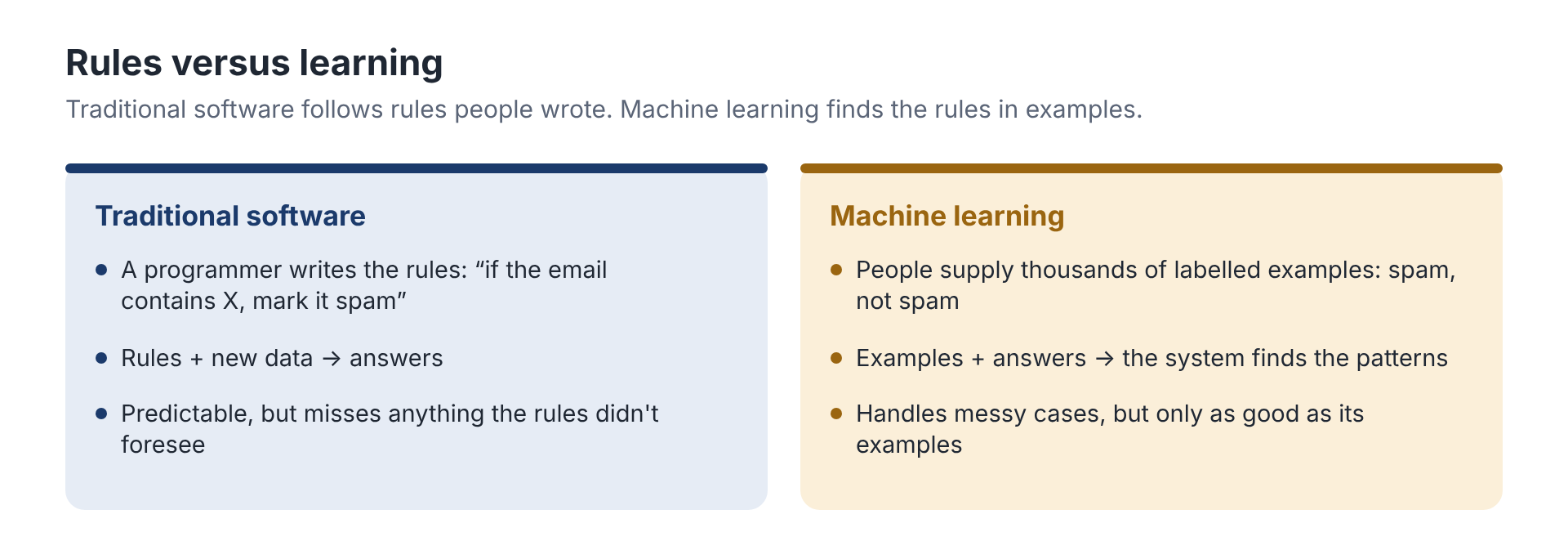
Rules are written by people; patterns are learned from examples.
How a language model learns to write
A large language model learns by reading enormous amounts of text and practising one thing: guessing the next word. After billions of guesses it gets very good at producing fluent, sensible language on almost any topic.
Developers then fine-tune it with human feedback, so it follows instructions, answers helpfully and refuses harmful requests. That’s why it can write a polite email or a summary on request, not just continue a sentence.
Why AI gets things wrong
AI is only as good as its examples. If the training data is old, it won’t know recent events. If it’s unbalanced, the AI can be unfair, for example recognising some accents or faces better than others. And because language models predict likely words, they can produce something that sounds right but isn’t.
That’s also why the same question can give slightly different answers. It isn’t looking up a fixed answer; it’s generating one each time.
Test it where you know the answer
Before release, developers test models on examples they haven’t seen and measure accuracy, errors and safety. You can do a small version of the same thing: try the tool on cases where you know the answer before trusting it on cases where you don’t.
Worked example: Testing an assistant before relying on it
Before: The test
Thandi, an operations coordinator, asked her company’s assistant three questions she already knew the answers to: one about the leave policy (with the policy pasted in), one about last quarter’s on-time delivery rate (without giving it the figures), and the first question again, worded differently.
After: What she found
- Leave policy, with the policy pasted: correct, and it quoted the right clause. 2. Delivery rate, no figures given: it gave a confident 91%, which was invented; the real figure was 86%. 3. Same question reworded: the same meaning, different wording.
It’s reliable when it works from material you give it. Without your material, it guesses.
Her rule from then on: for anything with numbers, paste the source and check the answer against it.
Key points
- Machine learning finds patterns in examples.
- Deep learning handles speech, images and language.
- Old or unbalanced data leads to errors and unfairness.
- Test it where you know the answer first.
Common questions
Does AI learn from my conversations?
Some tools can use conversations for training unless you switch it off; business plans usually don’t. Check your settings.
Why do I get different answers to the same question?
Language models choose likely words with some variety. Ask for sources or reasoning when it matters.
Exercise: Test an AI tool like a developer
Your version: pick the line for your area of work
- Operations: your delivery or production process
- Finance: your company’s month-end steps
- Sales and marketing: your products and prices
- HR and people: your leave policy
- Customer service: your most common customer questions
- Admin and coordination: your office procedures
- Training, L&D or skills development: a course you run
- Business owner or founder: your products, prices and terms
- Project or programme management: a project you know well
- Executive team: your organisation’s strategy
- Other (any role): your day-to-day work
Fifteen minutes with an approved AI tool. You’ll find out where it’s reliable for your work, and where it guesses.
Step 1: Write three questions you know the answers to
Use questions from your task (see “Your version” above): one where you paste the source material, one that needs facts from your company, and one general question about your field.
- ☐ You know the right answer to each
- ☐ Nothing personal or confidential in them
Step 2: Ask and score
Ask each question in a new chat. Score each answer: right, partly right or wrong. Note whether it said when it wasn’t sure.
Step 3: Ask one question twice
Reword one question and ask again. Compare: same meaning? Same facts?
Step 4: Write your rule
Finish this sentence and keep it where you’ll see it.
Prompt to copy:
Before I trust an AI answer about [type of task], I always check [what], against [which source].
Hand in: Write your three scores and your rule here.
Examples by industry: show the learner the line for their sector, or list them all
- Finance & Banking: a 60-page FAIS or Banking Code update, summarised for front-line staff.
- Retail: a supplier’s 40-page trading terms, summarised for buyers.
- Insurance: a 50-page policy wording, summarised as a plain-language guide for brokers.
- Medical & Healthcare: a medical scheme’s 30-page billing rules update, summarised for reception.
- Sports: the federation’s 40-page competition rules, summarised for team managers.
- Travel & Tourism: an airline’s 30-page fare rules and changes policy, summarised for consultants.
- Legal: a 120-page lease agreement, summarised as a one-page memo for the client.
- IT & Technology: a vendor’s 80-page security whitepaper, summarised for the risk committee.
- Human Resources: the Employment Equity Act amendments, summarised for line managers.
- Logistics: a client’s 40-page service-level agreement, summarised for controllers.
- Manufacturing: an ISO 9001 audit report, summarised into corrective actions.
- Public sector and education: a 90-page Auditor-General report, summarised into findings and actions.
- Agriculture: a market’s 50-page export protocol, summarised for the packhouse team.
- Mining: a 70-page DMRE inspection report, summarised into instructions and owners.
- Energy & Utilities: a NERSA determination or grid code update, summarised for engineers.
- Property & Construction: a 100-page JBCC contract, summarised into the key dates and obligations.
- Media & Publishing: the Press Code, summarised for new journalists.
- Telecommunications: an ICASA regulation update, summarised for the service team.
You’re done when: You’ve tested an AI tool on your own ground and have a personal rule for checking it.